Introduction to Foreign Account Tax Compliance Act (FATCA)
FATCA (Foreign Account Tax Compliance Act) requires all non-US financial institutions to search their records for customers with indicate a US person status and collect information about the tax residency (and Citizenship). FATCA applies to both personal and business accounts.
CRS (Common Reporting Standard) is a global reporting standard for the automatic exchange of information (AEoI). CRS allows tax authorities to obtain a clearer understanding of financial assets held abroad by their residents, for tax purposes.
A TIN (Tax Identification Number) identifies taxable persons (both personal and artificial persons) in the respective geography in which they operate. There may be instances where obtaining TIN is not required. In such cases the reason for non-obtaining of TIN is required under FATCA regulations.
FATCA and CRS reporting requirements validates TIN. If TIN is not available, then the reason for not having TIN has to be mentioned mandatory.
CRS and FATCA
The Foreign Account Tax Compliance Act (FATCA) is a tax law designed to prevent the US taxpayers from evading tax by enforcing Foreign Financial Institutions (FFIs) to report details of accounts held by US citizen and the income earned in those accounts to Internal Revenue service.
Common Reporting Standard (CRS) is a global reporting standard for the automatic exchange of information (AEoI) for countries other than US. CRS allows tax authorities to obtain a clearer understanding of financial assets held abroad by their residents, for tax purposes.
The solution framework for FATCA is provided below.
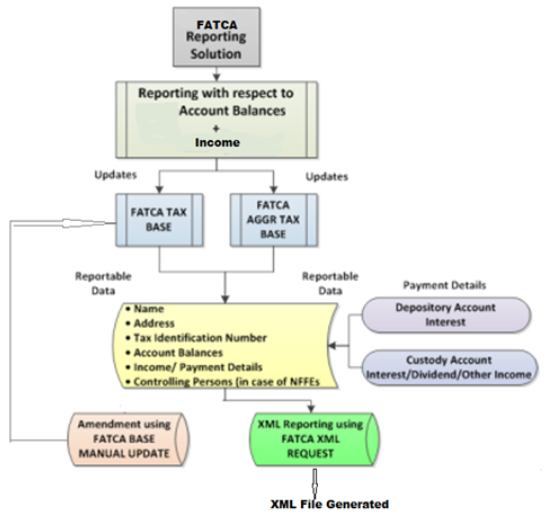
The solution framework for CRS is provided below.
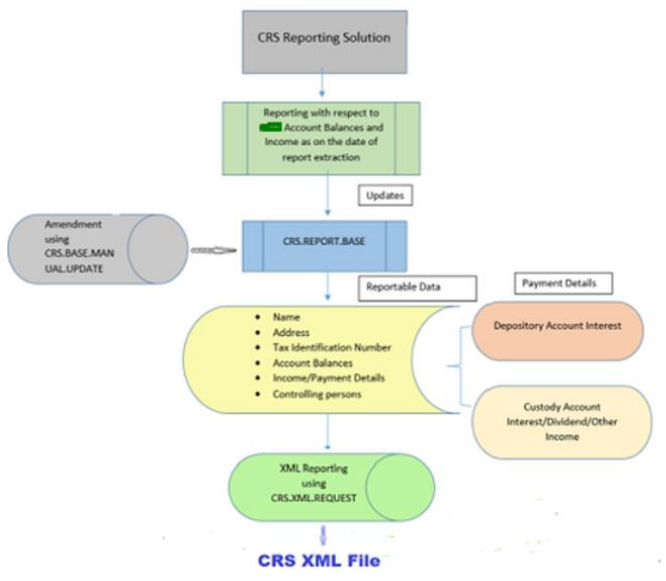
A few differences between FATCA and CRS are listed below.
|
|
FATCA |
CRS |
|---|---|---|
|
Purpose |
FATCA (Foreign Account Tax Compliance Act) is a legislation meant to help counter tax evasion in the US. |
CRS (Common Reporting Standard) is the global non-US equivalent of FATCA. |
|
Difference |
FATCA is applicable ONLY to US Citizens. However, each bank has its own parameters of identifying a customer who is a US Citizen governed based on the standards defined by FATCA/IRS. |
CRS is applicable for Non-US Citizens from Non-US countries registered with CRA. US Citizens is not in the Scope of CRS. |
|
Similarity |
To prevent offshore investors (US Citizens) from avoiding taxes and hoarding unaccounted cash overseas. |
To prevent offshore investors (non-US Citizens) from avoiding taxes and hoarding unaccounted cash overseas. |
|
Market Analysis |
Comparatively, the number of US Citizens reported under FATCA are only few. |
Whereas, in CRS, the number of reportable accounts is relatively on the higher side compared to FATCA, as this probably deals with all Registered Non-US Countries. |
|
Self-Certification Process |
Self-certification is the process whereby a Financial Institution asks their Account Holders to certify several details about themselves to determine the country or countries in which they are tax resident. There is a Separate Self Certification process for onboarding the FATCA related information from the customer. |
Self-certification is the process whereby a Financial Institution asks their Account Holders to certify several details about themselves to determine the country or countries in which they are tax resident. There is a Separate Self Certification process for onboarding the CRS related information from the customer. |
|
Withholding Tax |
The onus of identifying the client for FATCA Compliance is on the Reporting Financial Institution. Non-compliance could result in 30% withholding tax on certain US payments. |
There is no withholding tax under CRS. |
|
Data Privacy |
Since a lot of PII (Personal Identifiable Information) are captured during the process of Self Certification, Data Privacy needs to be given utmost importance and significance. |
Since a lot of PII (Personal Identifiable Information) are captured during the process of Self Certification, Data Privacy needs to be given utmost importance and significance. |
Temenos Transact provides a robust framework for banks and Financial Institutions to build FATCA or CRS reports. It can be broadly classified as a 3-step process which includes Client Identification, Withholding Tax and Reporting with Withholding Tax applicable only for FATCA and not for CRS. A brief overview of the above are mentioned below.
 Client Identification
The reportable financial institutions identify the reportable accounts by carrying out due diligence procedures. There are different due diligence procedures for the accounts held by individuals and entities. The basic customer information is captured in the CUSTOMER application. The additional supplementary details of the customer are captured in the FATCA or CRS related applications which are further used to classify a client as U.S or Non-US or client from participating jurisdictions.
The details related to FATCA client identification process is available in the following link: Introduction to FATCA Client Classification.
The details related to CRS client identification process is available in the following link: Introduction to CRS Client Identification.
Withholding Tax
Withholding tax is applicable only for FATCA. FATCA requires the Foreign Financial Institutions (FFIs) to report the income of US citizens to the US IRS annually. It also imposes a withholding tax of 30%, which is non-refundable, on US income paid to certain types of FFIs and Non-Financial Foreign Entities (NFFEs).
More details on this are available in the following link: Introduction to FATCA Withholding Tax.
Reporting
The FATCA Reporting module and CRS Reporting module provides a framework for the bank to generate the XML reports. More details regarding the FATCA and CRS Reporting modules can be referenced below.
The FATCA reporting by core is available in the following link: Introduction to FATCA Reporting.
The CRS reporting by core is available in the following link: Introduction to CRS Report.
In this topic