Introduction to Financial Risk Management
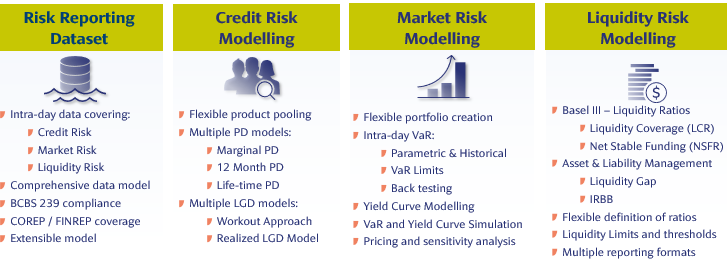
The FRM application is built on Analytics and Transact Data Hub (TDH) platform. It is integrated with Transact and is available as a pre-packaged and upgradeable risk management software. It enables the user to,
- Navigate complex regulatory and compliance landscape.
- Run sophisticated risk models.
- Ensure profitability and risk-informed decisions for greater efficiency and transparency.
The below diagram depicts the FRM modules.
Liquidity Ratios
Following the failure of many banks to adequately measure, manage and control their liquidity risk in 2007 and in subsequent years, the Basel Committee on Banking Supervision (BCBS) introduced two liquidity standards as part of the Basel III post-crisis reforms.
- Liquidity Coverage Ratio (LCR) - Enhances banks' short-term resilience.
- Net Stable Funding Ratio (NSFR) - Aims to promote resilience over a longer time horizon by creating incentives for banks to fund their activities with more stable sources of funding on an ongoing basis.
 Liquidity Coverage Ratio (LCR)
LCR is designed to ensure that the bank holds a sufficient reserve of High-Quality Liquid Assets (HQLA) to allow them to survive a period of significant liquidity stress lasting 30 calendar days. LCR seeks to promote short-term resilience of a bank's funding profile by ensuring that it has sufficient liquid assets to cover possible short-term liquidity outflows. Under the requirements, the bank is required to maintain an LCR requirement of at least 100%.
The LCR has two components:
- Value of the stock of High-Quality Liquid Assets (HQLA) in stressed conditions
- Total net cash outflows

Net Stable Funding Ratio (NSFR)
The NSFR is the amount of available stable funding relative to the amount of required stable funding. This ratio must be equal to at least 100% on an ongoing basis.
The NSFR has two components:
- Available Stable Funding (ASF) - The portion of capital and liabilities expected to be reliable over the time horizon considered by the NSFR, which extends to one year.
- Required Stable Funding (RSF) – A function of the liquidity characteristics and residual maturities of the various assets held by that institution and those of its Off-Balance Sheet (OBS) exposures.

Assets and Liabilities Management
Assets and Liabilities Management (ALM) in banking plays a crucial role in addressing two primary risks: liquidity risk and interest rate risk. ALM helps banks maximize net interest income by effectively pricing assets and liabilities within the institution’s risk parameters. In their normal operations, banks book assets, primarily loans and securities, and fund them with liabilities, such as deposits and borrowings. These assets and liabilities have different maturity dates, cash flows, and overall structures, often leading to natural mismatches in the bank’s liquidity profile.
To assess the impact of interest rate movements (interest rate risk) or changes in liquidity conditions due to structural mismatches (liquidity risk), banks use various measurement methodologies. These tools help determine how earnings or capital might be affected.
Liquidity Gap Analysis (LGA)
A liquidity gap occurs when there is a mismatch between a bank’s inflows and outflows from its assets and liabilities, caused by differences in customer behaviour. This gap can be positive or negative, depending on whether the bank experiences more inflows than outflows, or vice versa.
Interest Rate Risk in Banking Book (IRBB)
IRBB refers to the risk arising from adverse movements in interest rates that create a mismatch between the rates banks set on assets and liabilities. The Duration Gap analysis measures the sensitivity of the portfolio to interest rate changes, enabling the bank to periodically monitor and manage interest rate risk in the banking book effectively.
In this topic